“Free” is one of the most persuasive words in software. It lowers resistance, removes hesitation, and makes experimentation feel safe. In trading, where uncertainty is already high, that promise can be especially attractive.
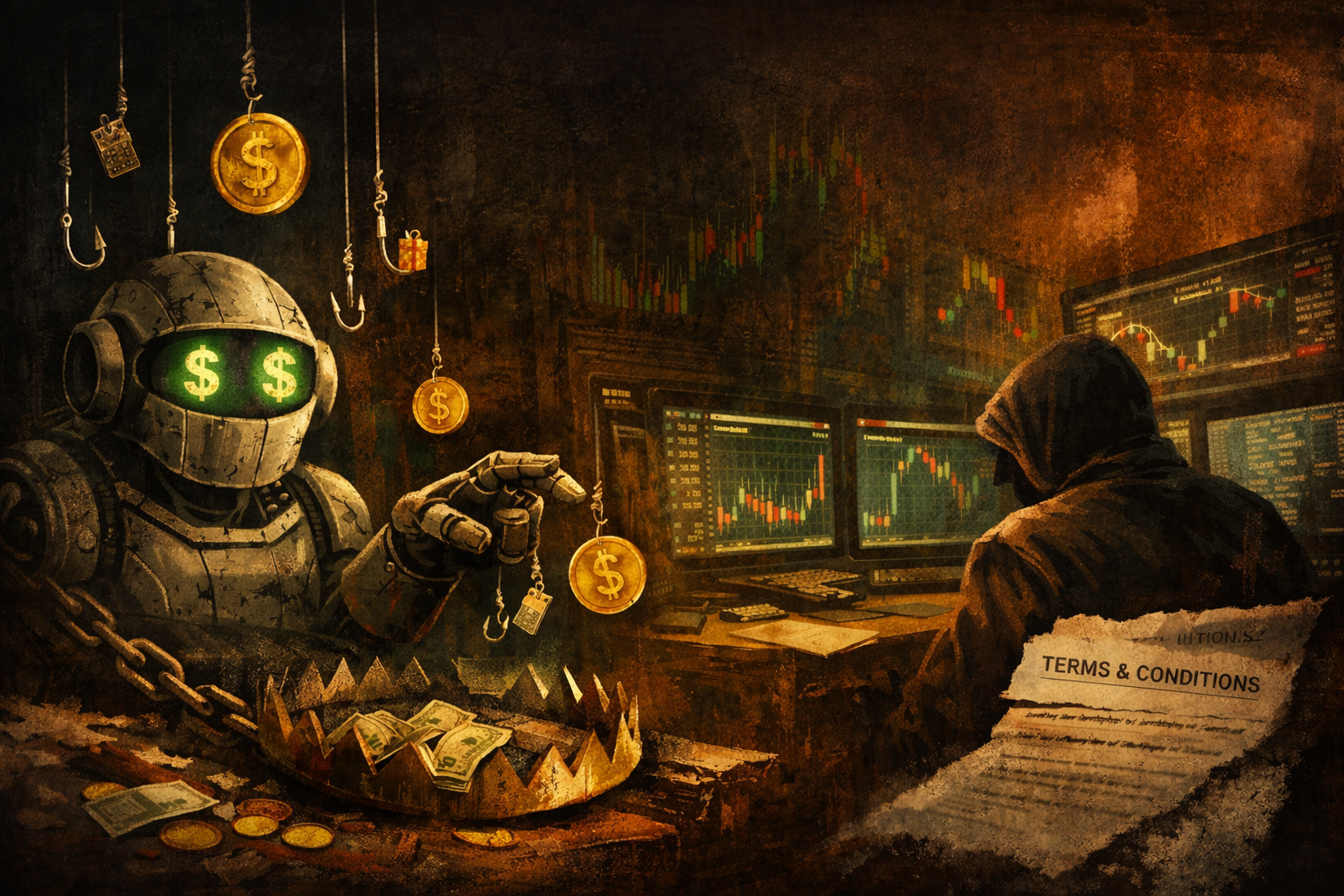
But free rarely means without cost. It usually means the cost is deferred, obscured, or paid in a different currency altogether.
Trading bots are no exception.
Any piece of software that runs continuously, connects to exchanges, processes live market data, and evolves over time has real operating costs. Development, maintenance, infrastructure, and support all require resources. When a trading bot is offered for free, those costs don’t disappear. They are simply absorbed elsewhere in the system, and the way they are absorbed shapes how the product behaves.
This is where incentives quietly begin to matter.
A free trading bot still needs to justify its existence as a business. That justification may not be obvious to the user, but it influences nearly every design decision. What gets prioritized, what gets delayed, and what never gets built are all downstream of that reality. Over time, the product begins to optimize not just for trading outcomes, but for whatever metric keeps it alive.
Often, that metric is engagement.
Free tools tend to reward activity. They benefit when users log in frequently, adjust settings often, and trade more. Not necessarily because this produces better results, but because attention and usage are measurable, monetizable signals. Even well-intentioned platforms drift in this direction. It’s not malicious. It’s structural.
For traders, the problem isn’t visible at first. Early on, everything feels generous. Features are unlocked, performance seems reasonable, and the absence of a price tag creates a sense of safety. The friction comes later, usually when conditions become less forgiving. That’s when limits appear, controls become constrained, or decisions start feeling guided rather than chosen.
It’s also when questions arise. Why did the bot behave this way? Why was that trade executed? Why is this setting unavailable? Transparency tends to thin out precisely when understanding matters most. By then, switching away feels costly, not financially, but cognitively. Familiarity becomes a form of lock-in.
None of this means free tools are inherently bad. They serve an important role. They allow experimentation without commitment. They help people learn market mechanics and understand their own tolerance for automation. They are often the right place to start.
But they are rarely neutral.
The moment a bot becomes part of a real strategy, something you rely on to operate consistently while you’re not watching, the underlying incentives begin to matter more than the feature list. At that point, alignment becomes more important than price.
Paying for software changes that relationship in subtle but meaningful ways. When the product has already been paid for, there is no need to maximize attention or encourage constant interaction. There is less pressure to upsell during moments of uncertainty. There is no requirement to withhold safety features to create artificial tiers. The software exists to do a job, and the user decides how much or how little to engage with it.
That doesn’t guarantee quality. Plenty of paid tools are poorly designed. But it does remove a layer of misalignment that often goes unnoticed until stress exposes it.
The most useful question, then, isn’t whether a trading bot is free. It’s who benefits when it runs. If the user, the software, and the business behind it all benefit in the same direction, the system tends to behave predictably. When those incentives diverge, the costs tend to surface at the worst possible time.
In trading, the most expensive decisions are rarely the obvious ones. They’re the quiet assumptions made early on, long before the market tests them.